As sponsors of this year’s CeFPro Vendor & Third Party Risk USA, we joined a timely discussion on what control really looks like when a critical supplier comes under strain. That was the focus of our speaking session, led by Wayne Scott, Governance, Risk & Compliance Solution Lead. One point came through: continuous monitoring matters, but it does not answer the harder question of what happens when a provider relationship starts to fail. Across the event, the same themes kept surfacing: concentration risk, AI-enabled third-party risk management, service deterioration, and stressed exit planning. For US financial services firms, resilience is moving beyond broad statements of intent and toward more precise questions about dependency, substitutability, and what is truly within the firm’s control.
A recurring point from our session was that resilience has to be evidenced, not just assumed. If a third party provides software, data, or a technology service that supports a critical process, firms need to understand what control they retain if that provider can no longer deliver. Can the service continue? Can the firm access what it needs? Can it transition without relying entirely on the supplier it is trying to exit? That is where software resilience gives firms a defined route to the materials and information needed to maintain, recover, or move a service when supplier support is no longer available. In that context, escrow is not a contractual provision. It is a practical control that helps turn critical dependency into manageable resiliency across the supplier lifecycle.
Technology escrow is a resilience measure for organizations that depend on third-party technology. Critical materials are held securely and can be released if agreed trigger events occur. These materials may include source code, documentation, data, build instructions, configuration details, or other assets needed to maintain or transition a service. The trigger could be insolvency, loss of support, or another event that puts continuity at risk. In that sense, escrow is a key control that supports resiliency planning, transition readiness, and stressed exits.
Software escrow works best when it is understood as part of a layered control environment. In risk and resilience terms, controls are often grouped into three categories: preventive controls, which reduce the likelihood of an issue occurring; detective controls, which identify when a risk is emerging or has materialized; and corrective controls, which support recovery and limit impact after disruption. Software escrow can support each of these control types when it is properly scoped, verified, and connected to wider third-party risk management and exit planning.
The discussion in New York reflected a view of vendor disruption in that, supplier failure is a concern, but firms are also focused on slower forms of risk that continuous monitoring may identify but cannot resolve on its own. Service deterioration can cause real disruption when performance slips, support weakens, or product quality drops without reaching formal default. Concentration risk was another key theme, especially where critical services rely on a small number of providers across core systems, cloud infrastructure, or specialist platforms. The more firms depend on the same providers for the same capabilities, the harder it becomes to assume stressed exit will be straightforward or alternatives will be available when needed.
AI was also part of the conversation, particularly in how third-party risk teams can work at greater speed and scale. Firms are looking at AI-enabled tools to help complete vendor questionnaires, review supplier evidence, and identify concern areas within materials such as SOC 2 reports or SIG questionnaires. Used well, this can help teams move through large volumes of vendor information more efficiently and focus attention on issues that need human review. But speed is useful only if it supports better control, clearer oversight, and stronger decision-making.
It is easy to say a supplier can be replaced. It is harder to show how that would work during financial distress, operational disruption, or a wider market event. A credible stressed exit policy needs to do more than name an alternative provider. It should map dependencies, set ownership, define triggers, and spell out the steps required to maintain service or transition safely. Software escrow matters because it helps make the plan usable. It supports access to the materials and information needed to continue, recover, or move when a supplier relationship breaks down. That is the difference between a policy that exists on paper and one that can support decisions.
That is why the control framework question matters. In many firms, third-party governance still leans heavily on due diligence, contractual protections, continuous monitoring, service level monitoring, and periodic review. Those remain important, but they do not always answer the central resilience question: what happens if a provider can no longer deliver and the business still has to? For mature third-party risk programs, the next step is joining governance to operability and making sure the controls described in policy can support real continuity outcomes. Software escrow is relevant because it helps convert dependency into something more manageable.
The practical takeaway is clear: effective third-party risk frameworks frameworks need software resilience and control measures that hold up when a critical provider becomes unstable. Continuous monitoring, supplier reviews, and contractual protections all have a role, but firms also need to understand what they can access, operate, or transition if a key technology supplier can no longer deliver. Software escrow and verification helps answer that question. It should be an important part of a broader approach to continuity, governance, and stressed exit planning: one that gives firms greater confidence that important services can continue when conditions are less than ideal.
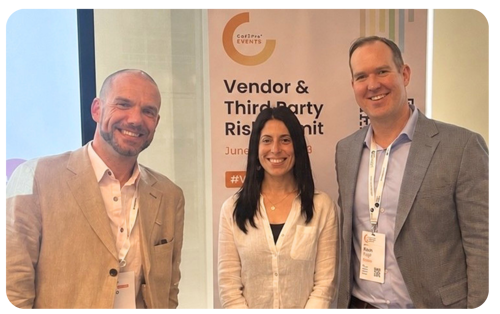
Wayne Scott, GRC Solutions Lead, Julie Antonelli, VP of Sales (NA), Kevin Gergel, Senior Account Director
Build a stronger software resilience strategy today. Book a demo to see our platform in action, or talk to our sales team for pricing details and solutions guidance.