Operational resilience is increasingly shaped by software dependency. Across the Middle East, organisations are recognising that continuity planning must extend beyond cyber defences to address what happens when third‑party software can no longer be supported.
Software escrow plays a growing role in this shift. By providing a structured, verifiable route to maintain critical applications in the event of vendor failure, escrow helps organisations manage continuity risk in regulated and high‑impact environments.
Saudi Arabia provides a strong reference point through the CST Software Escrow Guideline, but the underlying challenge is regional. As reliance on SaaS and cloud‑based platforms increases, organisations are re‑examining how they assure long‑term software availability and operational continuity.
Across the Middle East, organisations’ heavy investment in digital platforms to support growth, efficiency, and service delivery is continuing rapidly. From financial services and government systems to cloud-based enterprise applications, third-party software is foundational to a growing proportion of day‑to‑day operations across sectors in the region. As critical software dependency increases, so does risk.
Cybersecurity has been considered synonymous with digital resilience for years but recently there’s been a shift in the conversation. Organisations are recognising the reality: resilience is not only about defending critical systems, software and cloud applications. It also must ensure that essential software can remain available and maintainable if a supplier can no longer provide support. This shift is bringing renewed attention to software escrow as a practical continuity mechanism.
Software escrow exists to protect business continuity. It gives organisations a lever of control over third-party software dependency risk, by securely and independently holding the materials required to maintain a critical application and releasing them when predefined conditions, such as bankruptcy or service deterioration, are met. Within the region, where continuity planning, digital trust and supplier oversight are under closer scrutiny, software escrow is increasingly viewed as part of a wider operational resilience framework rather than the tick box exercise.
Saudi Arabia’s publication of the CST Software Escrow Guideline is clear evidence of this shift, and a significant milestone in the Kingdom’s digital maturity. But it’s also representative of that wider change in how software risk is being understood. Where previously cybersecurity controls dominated operational continuity and resilience conversations, a more holistic view means this now extends to the continuity of critical software and cloud applications.
Software escrow is sometimes assumed to mean simply putting a copy of the source code in secure storage with a neutral third-party. But that’s only the starting point.
If a critical software or SaaS vendor is unable to support their product anymore because of insolvency, acquisition, service withdrawal, operational failure or another agreed release event, then the beneficiary gains access to the escrow deposit. If that deposit cannot be rebuilt or maintained when released, it has very little value. For escrow to support continuity in a practical and meaningful way, the deposited materials must be complete, current and usable.
This is why verification is essential. It means reviewing deposited source code to confirm its integrity and completeness, validating that an application can be compiled, rebuilt, deployed and maintained with the right instructions. These checks highlight dependencies, omissions or errors so they can be rectified. So rather than assuming the escrowed code supports continuity, organisations have demonstrable proof that it can do the job they need it to do if their vendor fails.
The growing prominence of software escrow in the region aligns to how deeply embedded third-party software is within core operations.
In sectors across Saudi Arabia, such as financial services, public infrastructure, healthcare and other critical environments, that dependence is recognisable and growing. With the reliance on external software vendors to deliver essential services increasing, organisations must consider risk and resilience beyond cyber threats – including vendor insolvency, acquisition, strategic product withdrawal, loss of support or other unavailability.
These are not theoretical risks. They’re business continuity risks. And we’ve seen them happen.
The question that regulated and critical organisations need to ask is not whether they should consider software escrow, but where is it essential. Software availability is directly linked to service delivery, revenue and institutional trust. And whilst not every application requires escrow protection, being unable to maintain software that runs regulated activities, essential services or critical customer operations is a serious operational vulnerability.
Saudi Arabia currently has one of the clearest examples of escrow being positioned within a wider resilience and governance context. The Communication Space and Technology Commission’s (CST) Software Escrow Guideline is notable not simply for referencing escrow but reflecting a more mature national approach to software dependency risk. It positions escrow as part of a wider framework that supports trust, continuity and compliance.
Notably, the Saudi guideline advances a more refined view of continuity that includes escrow. It acknowledges that resilience must be operationally achievable, and not just a clause in contract added late-stage to satisfy the procurement process. This is particularly relevant in sectors, such as finance, critical national infrastructure and government, where system downtime can have significant consequences for service delivery, regulatory compliance and institutional trust.
The guideline presents a clear framework that embeds software escrow into procurement, governance and risk management processes to increase effectiveness, so instead of a reactive protection, organisations build preventative reassurance from the start. For the wider Middle East region, the Saudi guideline gives an important demonstration of how software escrow is helping organisations build a more holistic resilience stance, supporting operational continuity and digital trust.
The challenge that the Software Escrow Guideline is aimed at addressing in Saudi Arabia is not unique in the region. In markets such as the UAE, Qatar and Jordan the questions around third-party risk and continuity are becoming more pressing as digital dependency grows: how can organisations maintain continuity if critical systems depend on software that they do not directly control?
Increasingly, the answer lies in stronger assurance around software dependencies, clearer contingency planning and mechanisms that can be validated before disruption occurs. Software escrow contributes to this by reducing uncertainty around third-party failure and helping organisations plan for scenarios that may otherwise be difficult to mitigate.
Many critical systems today operate in SaaS or cloud native environments, supported by deployment pipelines, configuration scripts and operational documentation alongside the code itself. But software escrow has often been associated with on-premise programs and systems, where the source code is relatively static. But with this evolution of technology, so modern escrow solutions have evolved.
So, whilst Cloud or SaaS escrow still securely holds software source code and assets, it also accounts for how software is built, deployed and maintained. Modern escrow that captures the wider technical environment — not just the code — is increasingly important if continuity plans are to be workable in practice. This is why SaaS aligned escrow and verification approaches are gaining traction.
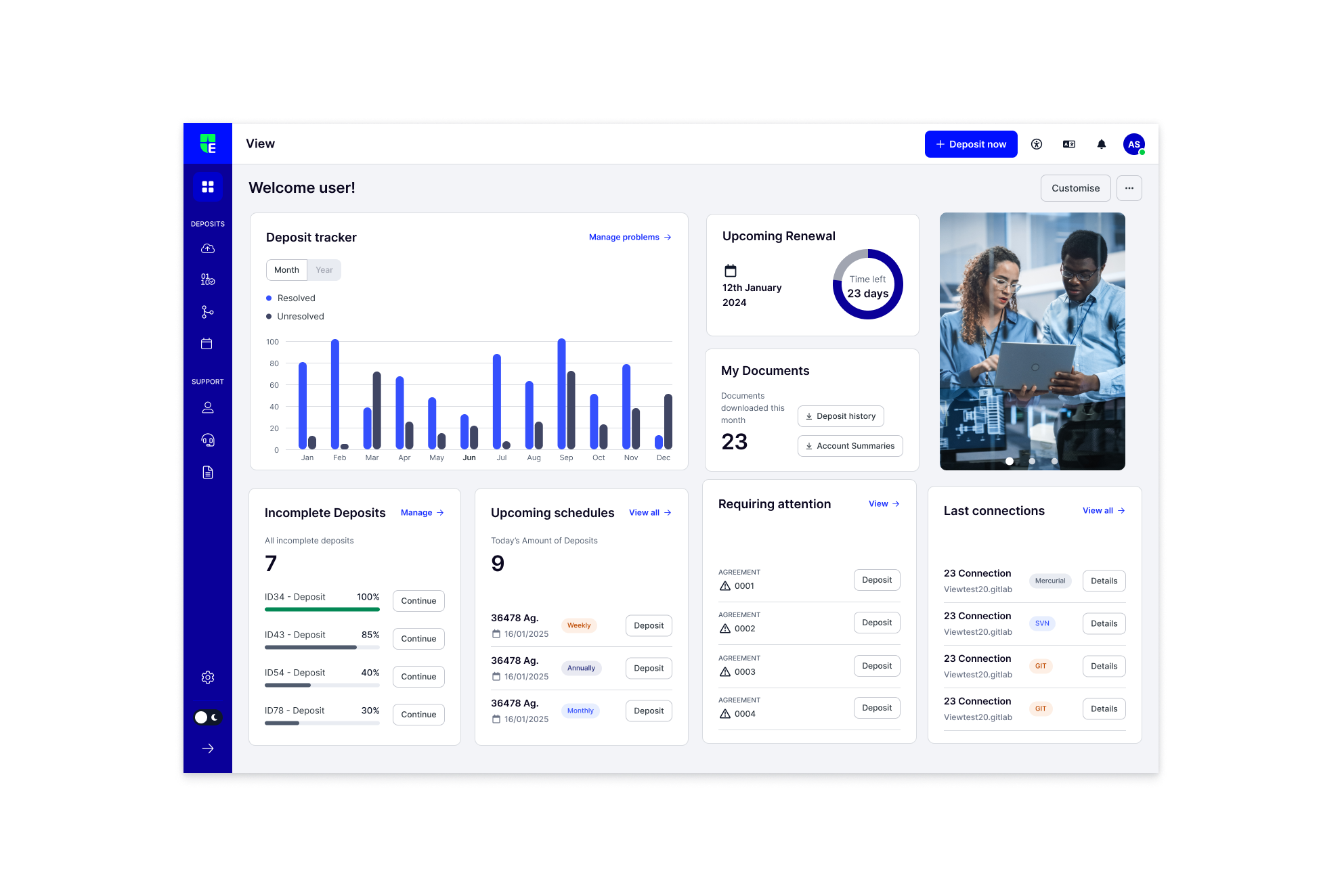
At Escode, our service evolves alongside the technology. Whether the software or application is on-premise or in the Cloud, the risk remains the same. That’s why we offer software escrow solutions for both environments, with integrated depositing, deposit reviews, as well verification and testing from our technical consultants. Our focus has always been giving client’s a reliable and practical means to recover if their critical software vendor fails – and that’s what we do.
More than ever before highly regulated and Enterprise organisations are putting potential suppliers under much more scrutiny around security and resilience during procurement. Regulators expect it and ultimately, whilst organisations can outsource their software, the risk is still theirs.
For software vendors operating within these sectors, there’s a commercial element to this discussion.
Software escrow readiness can demonstrate to potential licensees' operational maturity. It shows that continuity has been considered, dependencies have been acknowledged, and customers will not be left without options if circumstances change – in alignment with the risk and compliance concerns of the organisation. That can be an important differentiator.
For vendors seeking to enter new markets, potentially competing with global providers, and looking to build digital trust, CST-aligned escrow readiness can build credibility. It sends a clear message that the business is serious about reliability, resilience and that they understand potential customers’ regulatory priorities.
The shift we’re seeing in both attitudes and regulations is clear. Economies and critical infrastructure are built on software dependency, and so organisational resilience can’t be treated as purely a cybersecurity conversation – it must include software continuity.
Organisations must be able to rebuild, deploy and maintain the critical software that they rely on to function if they have a situation where their software vendor can no longer support the product. And they need to be able to demonstrate, to their board, to their regulators, that it can work when needed – with a technical validation that proves it supports continuity, rather than relying on the assumption of it.
This is where software escrow comes in.
It provides a structured, pre-agreed route to continuity when third-party support is disrupted. As operational resilience expectations continue to rise across the Middle East, escrow is becoming a more visible and practical component of how organisations manage long-term software risk.
Saudi Arabia may be setting the most formal example of this shift, but the underlying considerations are regional. As organisations strengthen resilience planning in an uncertain environment, software escrow is emerging as a credible and increasingly essential part of their resilience toolkit.

Director of Market Development, Middle East

As Escode’s Director of Market Development for the Middle East, Alex leads regional strategy and develops long-term partnerships with key clients and stakeholders. He brings more than 20 years of experience in software escrow and third-party risk management to the role, combining global expertise with regional insight.
Build a stronger software resilience strategy today. Book a demo to see our platform in action, or talk to our sales team for pricing details and solutions guidance.