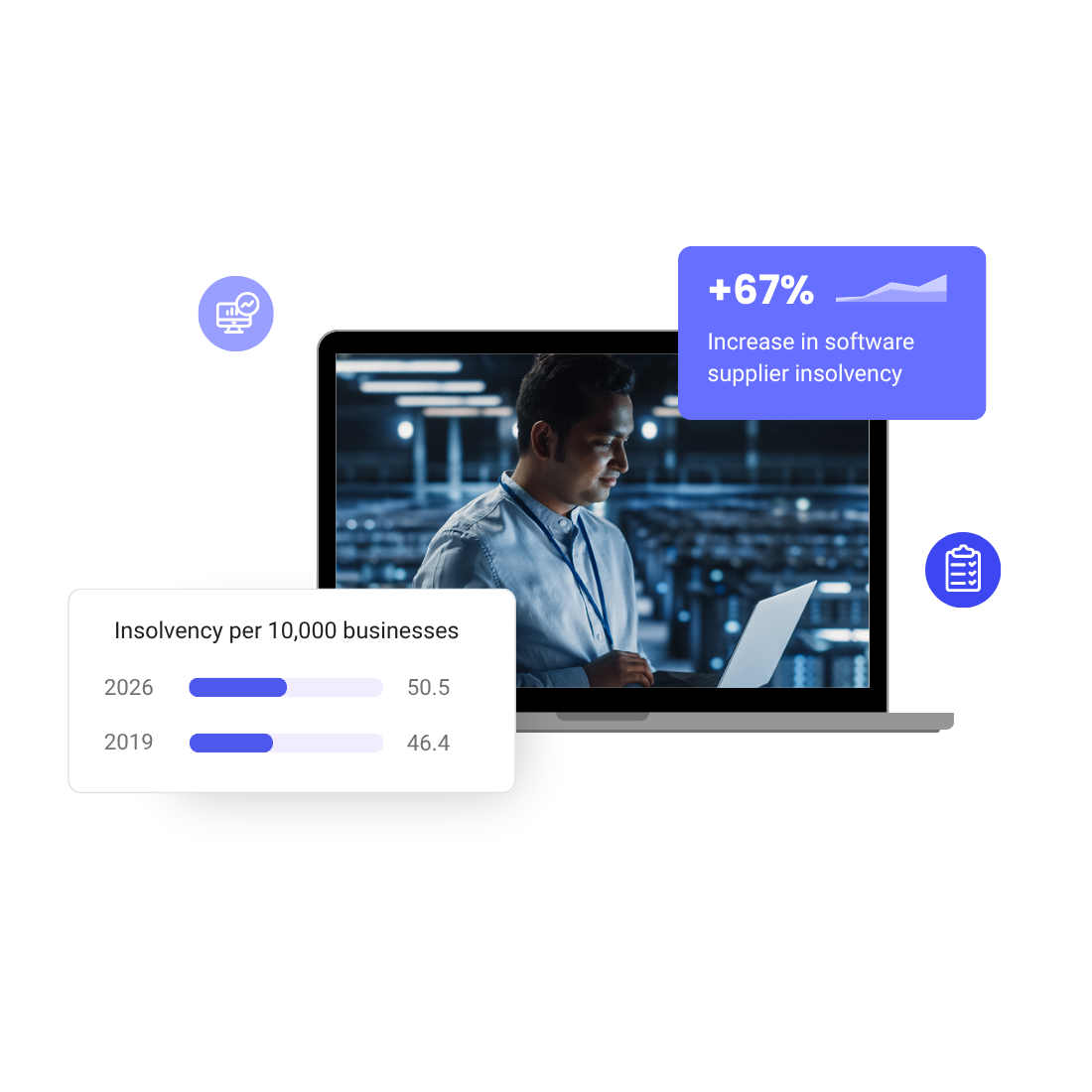
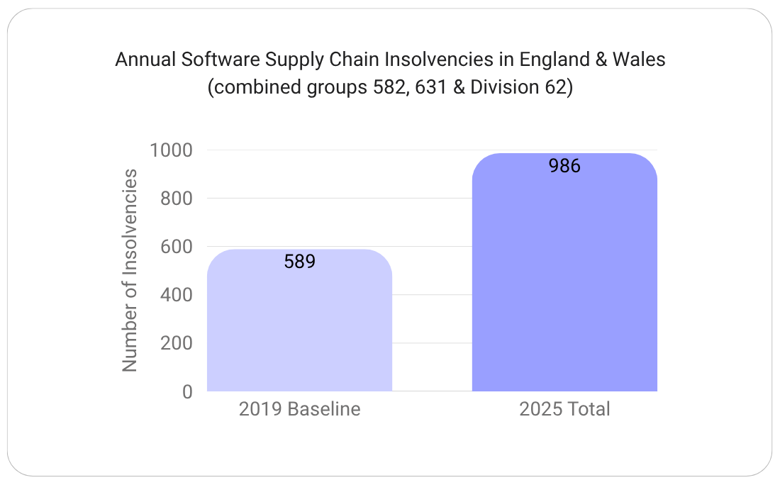
According to an analysis of the UK Insolvency Service official data release, the general National Rolling Insolvency Rate stands at 50.5 corporate insolvencies per 10,000 active companies, representing a 9% increase since 2019. However, business failures among technology vendors are outpacing the wider economy. Between 2019 and 2025, annual failures across software engineering, SaaS publishing, and cloud hosting providers in England and Wales rose 67.4% (from 589 to 986 annual cases). Overall company insolvencies increased by 39.4%, meaning software supply chain insolvency volumes grew 1.71 times faster than general UK commercial insolvencies.
Modern enterprise operations rely heavily on complex software supply chains, including third-party SaaS vendors, bespoke development partners, and cloud hosting infrastructure. The financial stability of these technology providers represents a critical risk to operational continuity, but too often this risk is overlooked by the people and teams who are tasked with mitigating against it.
Analysis of official UK government insolvency statistics by Escode has revealed a clear pattern: Insolvency volumes across software developers, SaaS publishers and cloud infrastructure providers are growing significantly faster than general UK commercial insolvencies since 2019. In recent years, the rate of insolvency has accelerated.
Key Index Highlights:
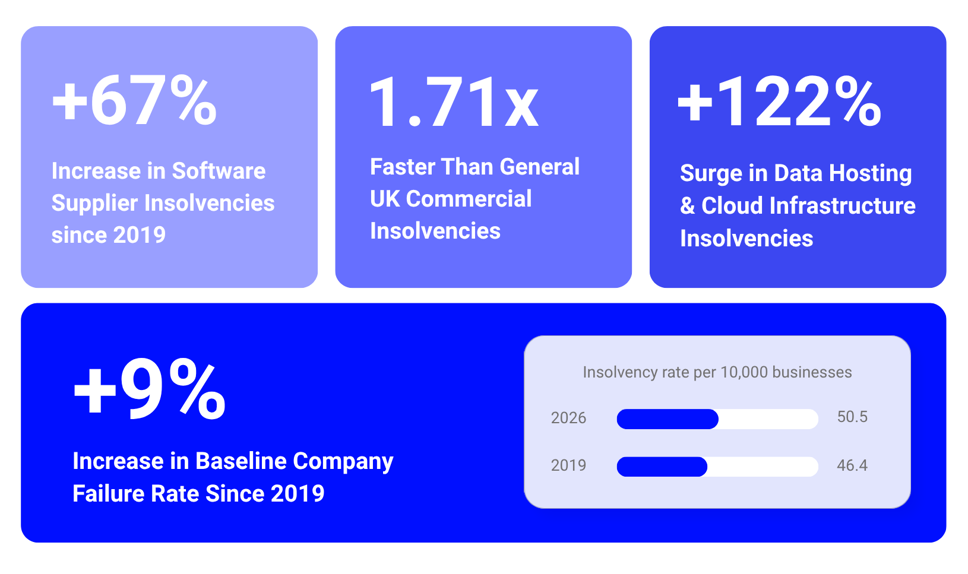
67.4% rise in core software supplier insolvencies: Business failures across core software engineering, SaaS publishing and cloud hosting providers rose from 589 in 2019 to 986 in 2025.
1.71x faster than general UK commercial insolvencies: Software supply chain insolvencies increased by 67.4% between 2019 and 2025, compared with a 39.4% increase in general UK commercial insolvencies.
9% increase in the baseline company failure rate: The rolling 12-month company insolvency rate stands at 50.5 per 10,000 active companies, compared with 46.4 in 2019.
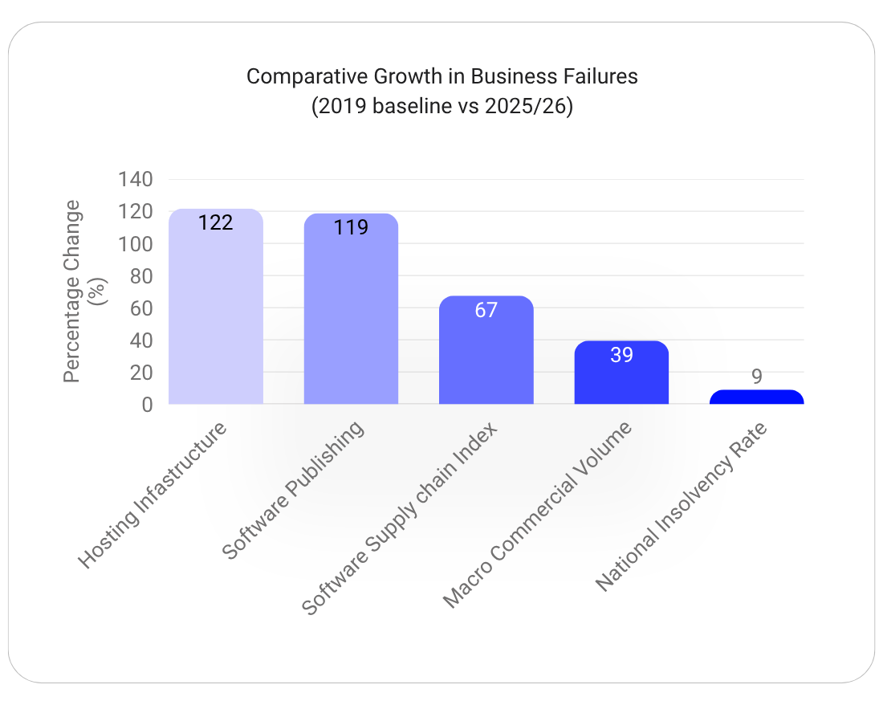
Software Publishing & Hosting failures more than doubled: Insolvencies across Software Publishing rose 118.8%, while Data Hosting & Cloud Infrastructure insolvencies increased 121.7% since 2019.
Key Finding | 01
The volume of business failures across core software engineering, SaaS publishing, and cloud hosting providers has scaled dramatically over recent years.
Graph 1
The Data Breakdown
Do not rely on static financial health checks performed during initial vendor onboarding. Establish a continuous risk loop that re-evaluates your business-critical SaaS providers.
"The rise in insolvencies among software and IT suppliers should be a warning sign for organisations that are increasingly dependent on third-party software and SaaS applications to run day-to-day operations. Many organisations still underestimate how exposed they are to software supplier instability until a failure occurs. When a critical software supplier becomes insolvent, the impact can be immediate, including the loss of access to essential systems and the data they rely on."

Luke Kelly, Operations Director at Escode
Key Finding | 02
The increase in failures is most pronounced across software publishing and cloud infrastructure providers, two segments that underpin many modern digital operations.
Graph 2
The Data Breakdown
Insights
Many organisations depend on SaaS applications and cloud infrastructure to support critical operations. The increase in failures across these sectors highlights the importance of understanding supplier dependencies and ensuring appropriate continuity measures are in place.
Map your software dependencies down to the hosting layer. Ensure that your critical SaaS vendors have verified, independent continuity measures in place to reduce the impact of disruption at an underlying infrastructure provider.
"Supplier risk does not stop with the organisations you contract with directly. Critical applications often rely on a wider ecosystem of cloud providers, hosting services and outsourced dependencies. Understanding these relationships can help organisations identify concentration risk and gain greater visibility of the software supply chain."

Wayne Scott, GRC Solutions Lead at Escode
Key Finding | 03
The pace of growth in tech supplier insolvency volumes is significantly outstripping the wider commercial landscape.
The Data Breakdown
Insights
If your organisation relies on hundreds of SaaS applications, integrations and software suppliers, insolvency volumes growing 1.71x faster than general UK commercial insolvencies have significant implications. As software ecosystems become more complex, supplier disruption becomes an increasingly important operational risk to manage.
Conduct a tiering audit of your software inventory. Identify the "Tier 1" applications that would halt critical operations if they disappeared tomorrow, and prioritise them for continuity planning.
"Many organisations have visibility of their software suppliers, but fewer have assessed them based on business criticality. By identifying Tier 1 applications and understanding the dependencies behind them, businesses can take a more targeted approach to resilience planning and supplier risk management."

Andrew Beaumont, Product Manager at Escode
Key Finding | 04
Headline business failures have flattened month-on-month, but the modern tech supply chain operates in an elevated risk environment.
The Data Breakdown
Insights
Although insolvency volumes have stabilised compared with recent levels, the rolling company insolvency rate remains above its 2019 level. For enterprise software buyers, this reinforces the need for ongoing supplier risk management and resilience planning, particularly for business-critical applications and services.
Make supplier risk reviews a recurring part of your procurement and governance processes. Regularly reassess critical software providers and verify that appropriate continuity and resilience measures remain in place.
Key Finding | 05
The rolling rate provides a clear indication of the level of company failure across England and Wales.
The Data Breakdown
Insights
If your organisation relies on a modern technology stack comprising hundreds of SaaS applications, integrations and software suppliers, a failure rate of 1 in 198 active businesses should not be overlooked.
While not every supplier presents the same level of risk, larger and more interconnected software ecosystems are naturally more exposed to supplier disruption. This reinforces the importance of identifying critical dependencies and ensuring appropriate continuity measures are in place.
Review the financial health of critical software suppliers at regular intervals, rather than only during onboarding or contract renewal.
Insights | Insolvency Drivers
The primary macroeconomic drivers of UK corporate insolvencies are high inflation, elevated borrowing costs, and weak consumer demand. These factors can reduce profitability, increase financing costs and place additional pressure on company cash flow, contributing to higher levels of formal Administrations and Creditors' Voluntary Liquidations (CVLs).
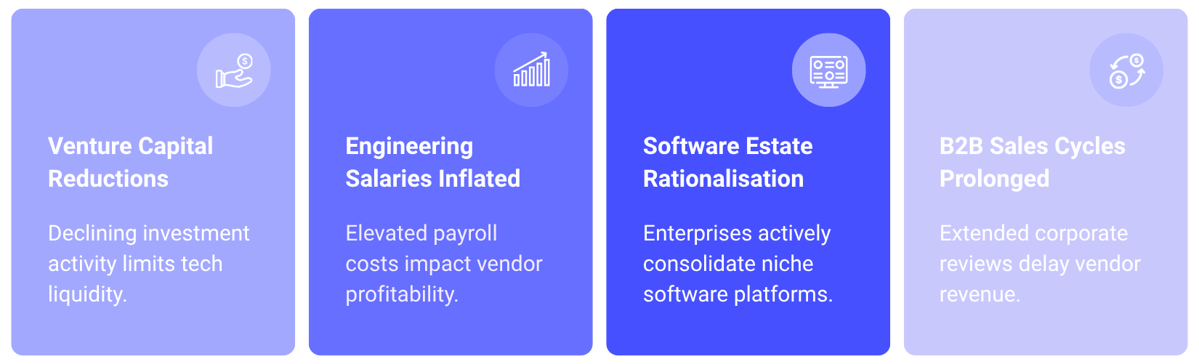
While macro pressures continue to affect businesses across all sectors, their impact has been amplified by several software-specific market dynamics. Together, these factors may have contributed to the faster growth in insolvency volumes seen across technology suppliers in recent years.
Guidance | Managing Software Supply Chain Risk
Uncontrolled vendor insolvency does not just mean losing a supplier, it can mean losing access to the critical applications, services and data that keep your business running. As organisations become increasingly dependent on third-party software, SaaS platforms and cloud services, traditional contingency plans and standard backups may no longer provide sufficient protection against supplier disruption.
Building technology resilience requires a proactive approach to software supply chain risk. By implementing the right resilience controls, organisations can reduce supplier dependency, strengthen continuity planning and improve their ability to respond when disruption occurs. Here are three key areas to consider when building resilience across your software supply chain.
01 | Strengthen Software Resilience with Software Escrow
If a critical software supplier can no longer support your application due to insolvency, acquisition or another disruptive event, your organisation needs a clear path to continuity.
02 | Implement SaaS & Cloud Resilience
As organisations become increasingly reliant on cloud-hosted and SaaS applications, continuity planning must extend beyond source code to include data, documentation and the wider application environment.
03 | Mandate Verification and Technical Validation
An escrow agreement is only as valuable as the materials it contains. If deposited source code is incomplete or cannot be rebuilt, continuity arrangements may not provide the assurance your organisation expects.
Escode’s Software Supply Chain Insolvency Index is updated quarterly.
Software supplier failures can have a significant impact on business continuity. Do you know where you're exposed?
Book a free consultation with an Escode specialist to review your software supply chain, identify critical dependencies and uncover potential resilience gaps.
✅ Review critical software suppliers and dependencies
✅ Identify resilience and continuity risks
✅ Receive practical, tailored recommendations
✅ Confidential, no-obligation consultation
Assess your exposure, strengthen resilience and improve continuity planning before disruption occurs.
By submitting this form you consent to receive correspondence from Escode. We will not sell your personal information. You can unsubscribe at any time. Privacy Policy.
Definitions
To provide actionable intelligence on risk for technology leaders, procurement teams, legal professionals, and risk officers, this index focuses strictly on the three Standard Industrial Classification (SIC) codes in England and Wales that represent software assets, custom source code development, and cloud hosting infrastructure [cite: 1.1.4].
| SIC Code & Level | Industry Description | Technology Supply Chain Context | UK Industry Examples |
|---|---|---|---|
|
Group 582 (SIC 58200) |
Software Publishing | Commercial software vendors and off-the-shelf SaaS applications integrated into critical operational workflows [cite: 1.1.4]. | Sage Group plc, Civica UK Ltd, Advanced Computer Software Group, Access Group, Ideagen Ltd |
|
Division 62 (SIC 62010–62090)
|
Computer Programming, Consultancy & Related Activities | Bespoke software development partners, systems integrators, and software engineering consultancies delivering custom source code [cite: 1.1.4, 1.1.5]. | Kainos Group plc, Softwire Technology Ltd, Endava UK Ltd, BJSS Ltd, Scott Logic Ltd |
|
Group 631 (SIC 63110) |
Data Processing, Hosting & Web Portals | Cloud infrastructure, application hosting providers, and managed server environments housing critical digital systems [cite: 1.1.2, 1.1.4]. | Iomart Group plc, Pulsant Ltd, Ans Group Ltd, Rackspace UK Ltd, Xe2 Ltd |
Evaluating the Data: National Failure Probability vs. Software Risk
To account for changes in the total number of registered businesses on Companies House, the official statistics also track the Company Insolvency Rate (failures per 10,000 active companies on the register).
The data confirms that the baseline probability of business failure is notably higher today than before the COVID-19 pandemic. When isolated to third-party software supply chains, the variance is even greater.
| Insolvency Focus Area | Pre-Pandemic Baseline (2019) | Verified Metric Used in This Analysis (2025/2026) | Verified Trend / Growth | Primary Source Reference |
|---|---|---|---|---|
|
National Rolling Insolvency Rate (Insolvencies per 10,000 active companies) |
46.4 per 10,000 |
50.5 per 10,000 (June 2026 rolling) |
+9.0% Rate Increase (Elevated baseline risk) |
Insolvency Service, Table 3 |
|
Macro Commercial Volume (All UK industries, England & Wales) |
17,170 annual cases |
23,942 annual cases (2025 total) |
+39.4% Volume Increase | Insolvency Service, Table 1a / 1c |
|
Group 582: Software Publishing |
16 annual cases |
35 annual cases (2025 total) |
+118.8% Increase (More than doubled) |
Insolvency Service, Table 1c |
|
Division 62: Programming & Consultancy |
550 annual cases |
900 annual cases (2025 total) |
+63.6% Increase (61.4% of all tech failures) |
Insolvency Service, Table 1c |
|
Group 631: Data Hosting & Cloud Infrastructure |
23 annual cases |
51 annual cases (2025 total) |
+121.7% Increase (More than doubled) |
Insolvency Service, Table 1c |
|
Refined Software Supply Chain Index (Combined Group 582, Div 62, Group 631) |
589 annual cases (2019 total) |
986 annual cases (2025 total) |
+67.4% Increase (1.71x faster than macro economy) |
Insolvency Service, Table 1c |
References & Methodology
All statistics in this report are calculated directly from official UK Government dataset releases: