What is Software Escrow?
Software escrow is a tri-party agreement between a Software Developer (Depositor), a Client (Beneficiary), and an Independent Agent. The agent securely vaults the source code and only releases it if specific trigger events occur, such as vendor insolvency, cessation of support, or a material breach of contract.
Guide to Software Escrow (2026 Edition)
Software Escrow is a critical framework for Operational Resilience and Third-Party Risk Management (TPRM). It ensures Business Continuity by securing Source Code, Build Environments, and Cloud Infrastructure (including IaC and SaaS Credentials). With strict standards like DORA, Software Escrow serves as a vital Exit Strategy, mitigating risks from vendor insolvency, material breaches, or cessation of support across cloud and AI environments.
How does the Software Escrow process work?
A standard arrangement operates through a tri-party agreement involving the Software Developer, the End-User, and the Escrow Agent. The workflow follows four distinct stages:
- Deposit: The developer uploads the source code, build instructions, and databases to a secure vault. Modern systems use automated syncing to pull data directly from repositories like GitHub or Bitbucket.
- Maintenance: The deposit is updated regularly to maintain version parity with the live production environment. This includes an updated Software Bill of Materials (SBOM) to track all third-party dependencies.
- Verification: The agent performs technical audits to confirm the code is complete, malware-free, and capable of a clean build into a functional application.
- Release: If a specific trigger event occurs, such as vendor insolvency, the agent transfers all materials to the customer to enable independent recovery and business continuity.
Common names and synonyms for Software Escrow
Software escrow is classified by the assets protected and the delivery model used. While the legal framework remains a tri-party agreement, specific terms define the scope of the technical deposit:
- Software Escrow: The standard umbrella term for the secure storage of source code and data by a neutral third party to ensure business continuity.
- Source Code Escrow: A specific focus on the human-readable programming files and internal logic of an application.
- AI Escrow: A specialised model for machine learning. It secures the model weights, training schemas, and hyperparameters required to rebuild an AI system.
- SaaS Escrow: A cloud-specific model for hosted apps. It prioritises "live" environment access, cloud credentials, and data snapshots over static code.
- Technology Escrow: A broad classification for the manufacturing and hardware sectors. It includes engineering designs, industrial formulas, and technical schematics.
- Intellectual Property (IP) Escrow: A legal-centric term covering trademarks, patents, and trade secrets that extend beyond executable software.
- Escrow as a Service (EaaS): A cloud-native delivery model featuring automated integrations with platforms like GitHub, GitLab, and AWS.
Software Escrow vs. Source Code Escrow: What is the difference?
While often used interchangeably, the primary difference lies in the scope of the deposit and the technical viability of the materials:
- Source Code Escrow: Focuses exclusively on the human-readable programming text. While essential for intellectual property protection, it lacks the dependencies required to execute the software.
- Software Escrow: A comprehensive deposit of the entire build environment. This includes the source code plus compilers, third-party libraries, API keys, and assembly instructions required to produce a functional, executable application.
Why businesses require Software Escrow in 2026
In 2026, software escrow is a core component of Operational Resilience and Third-Party Risk Management (TPRM). Businesses utilise escrow to secure the legal and technical right to maintain software independently if a vendor fails.
- Business Continuity: Protects mission-critical operations, such as HR, payroll, and payment engines, from service interruptions caused by vendor insolvency or cessation of support.
- Operational Risk Mitigation: Reduces concentration risk and dependency on single-source suppliers, safeguarding capital investments in custom and integrated software.
- Regulatory Compliance: Meets mandated resilience standards, specifically DORA for financial services and HIPAA for healthcare, which require proof of third-party continuity plans.
- Vendor Lock-in Prevention: Provides a defined exit strategy for SaaS-dependent workflows, ensuring data portability and system access if a provider changes ownership or withdraws support.
- SaaS Exit Strategy: Modern regulators now require firms to have a documented exit strategy for critical cloud providers. Software Escrow provides the technical mechanism for this strategy, ensuring that if a relationship is terminated or a provider fails, the business has the immediate means to migrate data and maintain service availability.
Which applications actually need a Software Escrow agreement?
Software escrow is necessary for mission-critical applications where vendor failure creates significant operational risk. If a program is easily replaceable or has low business impact, escrow is typically not required.
High-Priority Applications:
Common examples of applications that require escrow include:
- Financial & Banking Systems: Core transaction engines, payment gateways, and ledger systems where downtime results in immediate financial loss.
- Enterprise Resource Planning (ERP): Systems managing the global supply chain, inventory, and logistics.
- Customer Relationship Management (CRM): SaaS platforms hosting proprietary sales data and customer records.
- Bespoke & Customised Code: Software developed or modified specifically for unique business processes that cannot be bought off-the-shelf.
- AI & Machine Learning Models: Proprietary algorithms or automated decision-engines integrated into core business operations.
What is AI Escrow?
AI Escrow is a specialised legal and technical agreement where a neutral third party secures the critical components of an Artificial Intelligence system, including model weights, training data schemas, and hyperparameters, to ensure a business can maintain or rebuild the AI if the vendor goes bankrupt or stops providing support.
Unlike traditional software escrow, which only protects static source code, AI Escrow secures the "intelligence" of the model, allowing a company to keep proprietary algorithms running without the original developer.
Software Escrow for AI and Machine Learning applications
With AI adoption reaching 88% and AI projects failure rate at 80%, AI Escrow has become a critical requirement for managing Third-Party Risk. Especially with 76% choosing to purchase AI and outsource development rather than building solutions entirely in-house. Unlike traditional software deposits, AI applications require a broader set of assets to ensure model reconstruction and operational continuity.
Key Components of an AI Escrow Deposit:
- Model Weights & Parameters: The specific learned values that define the behaviour of a trained neural network.
- Training Data Schemas: Documentation of data structures, cleaning scripts, and pre-processing pipelines required to retrain or update the model.
- Hyperparameters: The configuration settings used to control the learning process and model architecture.
- Hardware Configurations: Specific GPU/TPU requirements and environment dependencies (e.g., CUDA versions or specialised cloud instances) necessary for a clean build.
- API & Integration Keys: Secure access to the underlying LLM or foundational models if the application utilises a wrapper architecture.
SaaS Escrow vs. Traditional Software Escrow
The distinction between these models is based on the hosting environment and the speed of recovery.
- Standard Software Escrow: Focuses on the long-term preservation of Source Code and Build Environments. It allows a user to rebuild an application from scratch but does not provide immediate service restoration.
- SaaS Escrow: Designed for Operational Continuity of cloud-hosted applications. It secures the "live" components required to keep a service online during a vendor failure, moving beyond static code to include infrastructure and data.
Key Components of SaaS Escrow:
- Cloud Credentials: Root-level administrative access to the vendor’s production environment (AWS, Azure, or GCP).
- Live Data Snapshots: Frequent, independent backups of customer-specific databases to ensure zero or minimal data loss.
- Infrastructure as Code (IaC): Automated deployment scripts, such as Terraform or Kubernetes manifests, used to replicate the hosting environment.
- SaaS Continuity (Hot Failover): A pre-configured, dormant instance of the software that can be activated immediately to prevent service downtime.
Want to see which of your SaaS applications are at risk of failure? Try our free SaaS Risk Assessment Tool.
SaaS Continuity in Action
“The Escrow as a Service (EaaS) solution provided by Escode, has enabled us to embrace the cloud with complete peace of mind in the knowledge that our services are robust and secure.”
Les Freer, Director at Heathrow Express
What is a Software Escrow Agreement?
A Software Escrow agreement is the formal legal contract that governs a tri-party relationship between a vendor, a customer, and an independent agent. This contract establishes the legal obligation for the vendor to deposit their Intellectual Property (IP) into a secure vault. It defines the specific release conditions, permitted use rights, and dispute resolution procedures required to ensure the customer has a legally enforceable right to access the software if the vendor fails.
Common types of Software Escrow Agreements
- Single-Licensee: Best for protecting a specific, custom software purchase. It creates a direct, private link between one vendor and one customer.
- Multi-Licensee: Ideal for developers offering an umbrella of protection to all their customers. Multiple users share the cost of a single, standardised deposit.
- SaaS & Cloud Continuity: Focuses on service uptime, not just code. It secures the cloud credentials and database snapshots needed to keep an application online.
- AI Escrow: Specialised for machine learning. It protects the model weights and training schemas required to rebuild an AI system from scratch.
- Master Agreement: Designed for enterprise portfolio management. It allows a company to manage dozens of different software vendors under one set of standard terms.
- Technology & Hardware: Used for industrial systems. It protects physical schematics and manufacturing formulas alongside the core software.
- Development & Data Holding: Safeguards projects still in the build phase. It ensures you have the latest data if a developer stops working mid-build.
Unsure which agreement you need? Download a free Software Escrow Agreement Template.
Standard terms found in a Software Escrow Agreement
A software escrow agreement governs the obligations of the Depositor, Beneficiary, and Agent. The following clauses are essential for establishing operational resilience:
- Deposit Materials: Defines the specific assets stored, including source code, technical documentation, build instructions, and API keys.
- Deposit Frequency: Sets the timeline for updates, such as daily automated syncing or manual deposits upon every major software release.
- Maintenance & Updates: Ensures version parity by requiring the deposit to match all new security patches, releases, and environment changes.
- Verification Rights: Grants the customer the legal right to perform a technical audit to confirm the code is complete and functional.
- Release Conditions: Lists the specific trigger events, such as insolvency or SLA breaches, that allow the agent to transfer materials to the user.
- Permitted Use: Restricts the user to using the released code for internal support only, prohibiting commercial resale or distribution.
- Fees & Payment: Outlines the cost allocation for setup, annual vaulting, and technical verification between the vendor and customer.
- SaaS Continuity: Cloud-specific requirements for depositing database snapshots, IaC scripts (Terraform), and infrastructure credentials.
- Indemnification & Liability: Defines the financial limits of the agent’s responsibility and protects all parties from third-party IP claims.
- Termination & Expiry: Outlines how the agreement ends, typically tied to licence cancellation. In 2026, these clauses are often integrated into a firm’s wider Third-Party Risk Management (TPRM) policy to ensure a smooth transition during vendor off-boarding.
- Dispute Resolution: Formal steps, including technical arbitration, to resolve disagreements if a vendor contests a release request.
What triggers a Software Escrow release?
Release events are specific legal conditions that authorise the transfer of materials to the customer. Common triggers include:
- Insolvency or Bankruptcy: The vendor is legally declared unable to pay debts, enters liquidation, or ceases trading.
- Discontinuation of Support: The vendor officially stops providing critical maintenance, security patches, or technical servicing for the application.
- Material Breach of Contract: The vendor fails to remedy critical software bugs or meet established Service Level Agreements (SLAs) within a set notice period.
- Acquisition or Ownership Change: Intellectual property is transferred to a third party or competitor that fails to maintain equivalent levels of protection.
- Failure to Deposit: The vendor fails to update the escrow vault with the latest source code or documentation as required by the agreement.
What should be included in a Software Escrow deposit?
A comprehensive deposit includes all technical and legal assets required to compile, deploy, and maintain the software independently:
- Source Code: The programming files and application logic needed to modify the software.
- Build Environment: Compiler settings and instructions required to turn code into a working application.
- System Documentation: Architecture diagrams, API specifications, and maintenance manuals for technical teams.
- Access Credentials: Admin passwords and root-level logins for AWS, Azure, or GCP cloud accounts.
- Infrastructure as Code (IaC): Automated deployment scripts, including Terraform or Kubernetes scripts used to rebuild the hosting environment automatically.
- Data Snapshots: Backups of production databases and datasets needed to restore your specific records.
- Virtualised Environments: Docker or VMware images that replicate the full production setup.
- Dependency Management (SBOM): A Software Bill of Materials listing all third-party libraries and proprietary plugins.
- Hardware Specifications: Engineering schematics and circuit diagrams for industrial or IoT systems.
- Proprietary Intellectual Property: Industrial formulas, recipes, or manufacturing steps critical to the product.
Automated Repository Integration:
To maintain version parity, modern deposits use REST API hooks for daily automated syncing from GitHub, GitLab, and Bitbucket. This ensures the escrow vault always matches the live production branch.
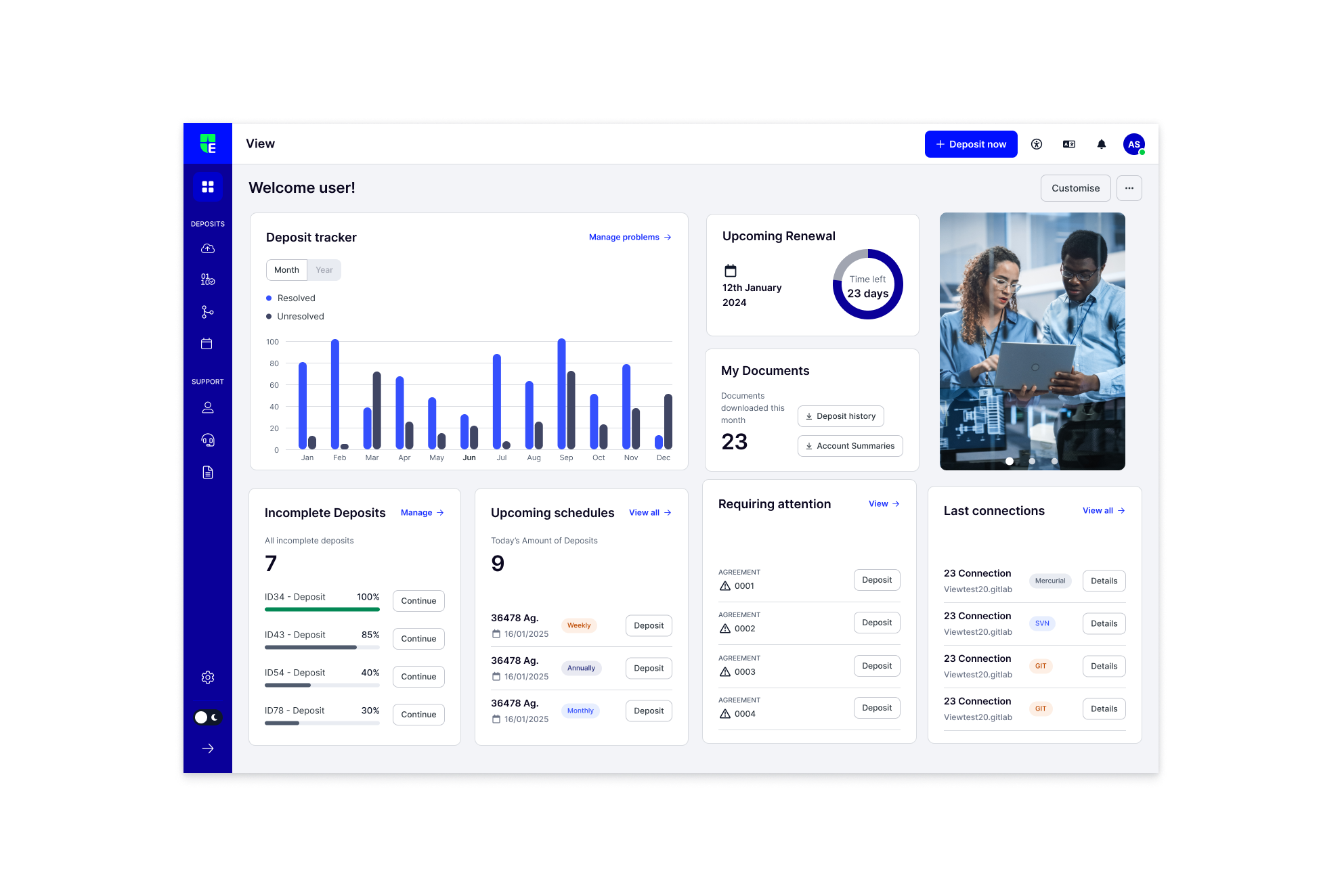
Using GitHub, GitLab or Bitbucket? Learn more about our Escode View Portal Integrations.
What is Software Escrow Verification?
Verification is a technical audit performed by an independent engineer to ensure that escrowed materials are complete, functional, and ready for independent deployment. It moves beyond simple storage to validate the build environment and prove the software can be successfully compiled and restored without assistance from the original vendor.
Operational Resilience through Verification
“The Software Escrow and verification processes have given us the confidence that, even in the event of a vendor failure, we can continue operating our critical applications without disruption. This approach supports both our compliance obligations and our broader digital transformation strategy.”
Maria Ambrozi, Senior Product Owner Flight Operations Support & Innovation
Levels of Software Escrow verification explained
Escrow verification is a technical audit used to confirm that deposited materials are complete and viable for independent recovery. Rather than a one-size-fits-all approach, organizations choose a verification level based on the technical complexity and criticality of the application:
- Integrity Testing: A foundational check to ensure all deposited files are uncorrupted, accessible, and free of malware or viruses.
- Full Build Verification: An independent replication of the build process to prove the source code can be successfully compiled into a functional, executable application.
- SaaS Continuity & Cloud Failover: A live simulation of a vendor outage to verify that the application can be restored using the deposited cloud credentials, database snapshots, and infrastructure scripts.
- Usability & Deployment Review: A technical assessment of build instructions and documentation to ensure a third-party developer can maintain the software without the original vendor's assistance.
How much does Software Escrow cost?
Software escrow investment is determined by application complexity and the required level of technical assurance.
- Setup & Integration (£750 – £1,250): A one-time fee for legal drafting and technical integration with repositories like GitHub or Bitbucket.
- Annual Maintenance (£1,400 – £1,850): Recurring costs for secure vaulting, legal account management, and agreement administration.
- Technical Verification (£1,500 – £15,000+): Project-based fees for independent audits, ranging from Integrity Testing to full build environment replication.
Need a formal quote for your project? Request a Customised Software Escrow Quote
Who pays the Software Escrow fees?
Fees are distributed between the Depositor and Beneficiary to maintain the independence and security of the agreement:
- Setup Fees (Typically paid by Vendor): Usually covered by the software developer as part of the initial onboarding and repository integration.
- Annual Fees (Typically paid by Customer): Primarily funded by the beneficiary. This ensures the protection remains active even if the vendor faces financial difficulty.
- Verification Fees (Typically paid by Customer): Funded by the party requiring technical proof that the code is complete and functional.
How to choose the right Software Escrow agent
Selecting the right partner is a balance between technical automation and legal security. You should evaluate an agent based on four critical factors:
- Automation & Integration: Modern agents should integrate directly with GitHub, GitLab, or Bitbucket to pull code updates automatically. This ensures the escrow deposit is never out of date.
- Security & Compliance: Are they a neutral, bonded third party with ISO 27001 certification? You are trusting them with your most valuable intellectual property; they must have the same security credentials as a Tier-1 data centre.
- Technical Verification: Can they move beyond simple storage? A quality agent must have the in-house technical staff to perform Full Build Verifications, actually compiling the code to prove it works, rather than just checking that the files exist.
- SaaS & Cloud Expertise: Can they handle live environments? The agent needs to prove they can manage cloud snapshots and AWS/Azure/GCP credentials to ensure the software stays online, rather than just storing static code.
- Global Jurisdiction & Data Sovereignty: The agent must be able to handle cross-border legalities. This includes ensuring Software Escrow deposits comply with local data laws (such as UK GDPR) and that the agreement is governed by a reliable legal jurisdiction (e.g. English Law) to ensure it is enforceable regardless of where the developer is based.